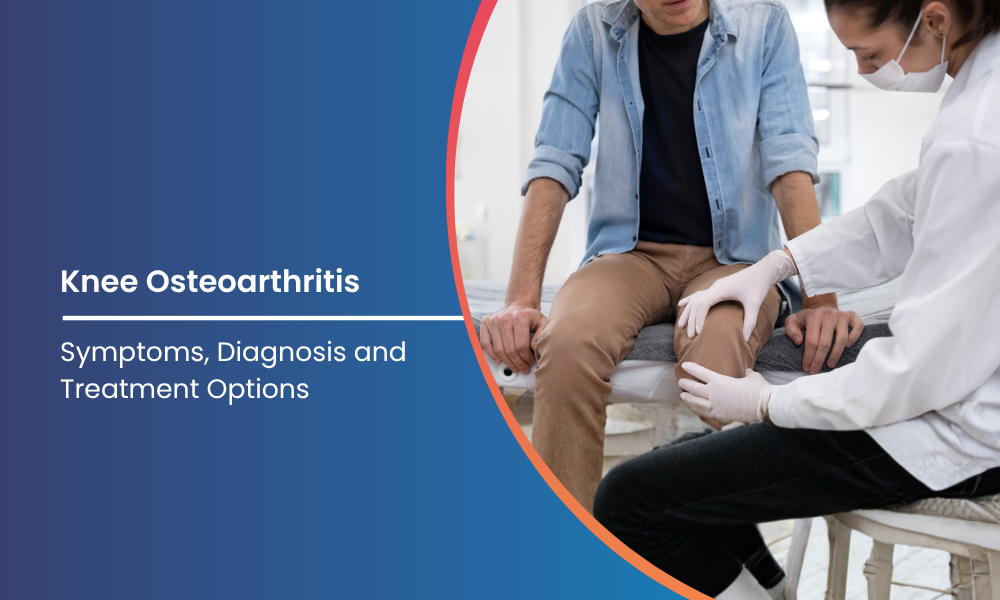
Knee Osteoarthritis Symptoms Diagnosis and Treatment
Overview
Knee pain is a common health concern that can affect everyday activities such as walking, climbing stairs, sitting down or getting up from a chair. While occasional discomfort may result from physical activity or minor injuries, persistent knee pain accompanied by stiffness or reduced movement may indicate an underlying joint condition.
One of the most common causes of long-term knee discomfort is knee osteoarthritis, a condition characterised by gradual changes in the cartilage, bones and other tissues within the knee joint.
Osteoarthritis commonly develops with increasing age, but it can also affect younger adults, particularly those with previous knee injuries or certain risk factors. Symptoms may develop gradually, making them easy to overlook early on.
Although knee osteoarthritis is a long-term condition, it does not always lead to severe disability or require surgery. Many people manage their symptoms through physiotherapy, appropriate exercise, medicines and other non-surgical approaches. For individuals with advanced joint damage and significant functional limitations, knee replacement surgery may be considered.
Understanding knee osteoarthritis symptoms, diagnostic tests, and treatment options can help patients seek appropriate care and maintain mobility.
This guide explains what causes knee osteoarthritis, how it is diagnosed, the available non-surgical and surgical treatments, and when to consult an orthopaedic specialist.
What Is Knee Osteoarthritis?
Knee osteoarthritis is a degenerative joint condition that affects the knee's cartilage, underlying bone, and surrounding tissues.
Cartilage is a smooth, protective tissue covering the ends of bones within a joint. It helps bones move against each other with minimal friction and absorbs some of the forces generated during movement.
In a healthy knee, cartilage allows smooth movement between the thigh bone (femur), shin bone (tibia) and kneecap (patella).
With osteoarthritis, the cartilage gradually changes and may thin or become damaged. The underlying bone can also change structurally, including developing bony growths called osteophytes.
The condition may additionally involve inflammation of the joint lining and changes to surrounding muscles and ligaments.
These developments can contribute to knee pain, joint stiffness, swelling and restricted movement.
Knee osteoarthritis is not simply a consequence of ageing or ordinary wear and tear. It involves biological and mechanical changes throughout the joint, and its progression varies considerably between individuals.
What Are the Early Symptoms of Knee Osteoarthritis?
Symptoms often begin gradually and may become more noticeable during routine activities.
Some people experience mild discomfort for years, while others develop more significant functional limitations.
1. Knee Pain During Movement
Knee pain is one of the most common symptoms of osteoarthritis.
It may develop while walking, climbing stairs, squatting or standing for extended periods.
In the early stages, discomfort often improves with rest. As the condition progresses, pain may occur during less demanding activities or sometimes at rest.
Pain intensity does not always match the amount of joint damage visible on an X-ray.
2. Joint Stiffness After Rest
People with knee osteoarthritis may have difficulty moving their knee after waking up or sitting for along timed.
This is sometimes called start-up stiffness.
Morning stiffness associated with osteoarthritis typically lasts less than 30 minutes and improves as the joint begins moving.
Prolonged morning stiffness may suggest another type of arthritis and should be medically evaluated.
3. Swelling Around the Knee
Osteoarthritis can cause intermittent swelling due to inflammation within the joint or changes in the surrounding tissues.
The knee may appear mildly enlarged or feel uncomfortable after increased activity.
Sudden, severe swelling requires assessment because it can also occur with injuries, gout or infection.
4. Grinding or Clicking Sensations
Some patients notice clicking, cracking or grinding sensations when bending or straightening the knee.
This is called crepitus.
Joint noises are common and do not always indicate osteoarthritis. However, persistent noises accompanied by pain, swelling or restricted movement may warrant evaluation.
5. Reduced Range of Motion
As osteoarthritis progresses, fully bending or straightening the knee may become difficult.
This can affect activities such as climbing stairs, sitting on the floor or getting into a vehicle.
6. Difficulty Walking or Climbing Stairs
Pain and joint stiffness may make everyday movements more challenging.
Some people walk more slowly, avoid stairs, or need frequent breaks during activities.
7. Knee Instability
A person may feel their knee is weak or occasionally gives way.
This sensation may be associated with muscle weakness, pain or changes in joint mechanics.
Persistent instability increases fall risk and should be assessed.
What Causes Knee Osteoarthritis?
Knee osteoarthritis develops through a combination of biological and mechanical factors.
There is rarely a single identifiable cause.
Increasing Age
The likelihood of osteoarthritis increases with age because joint tissues' ability to maintain and repair themselves can change over time.
However, osteoarthritis is not inevitable, and many older adults maintain good joint function.
Previous Knee Injuries
A history of ligament tears, meniscus injuries, or knee fractures can increase the likelihood of developing osteoarthritis later in life.
These injuries may alter joint stability or change how forces are distributed across the knee.
Repetitive Joint Stress
Certain occupations or activities involving frequent kneeling, squatting, or heavy physical work may increase the risk of knee osteoarthritis.
However, regular physical activity and properly performed exercise generally benefit joint health.
Body Weight and Joint Loading
Greater body weight can increase the mechanical load on the knees during walking and other activities.
Metabolic and inflammatory factors may also contribute.
When clinically appropriate, individualised weight management can help reduce pain and improve physical function.
Family History
Genetic factors can influence joint structure, cartilage health and susceptibility to osteoarthritis.
Having relatives with osteoarthritis may increase risk, but it does not mean you will necessarily develop the condition.
Joint Alignment
Differences in leg alignment can change how pressure is distributed within the knee.
For example, bow-legged or knock-kneed alignment may increase loading on particular areas of the joint.
How Is Knee Osteoarthritis Diagnosed?
Diagnosis is based primarily on symptoms, medical history and physical examination.
Many adults with typical osteoarthritis symptoms can be diagnosed clinically without routine imaging. Additional investigations may be required if symptoms are unusual or another condition is suspected.
NICE
Step 1: Medical History
An orthopaedic specialist may ask about the location and duration of pain, morning stiffness, previous injuries and activities that worsen symptoms.
The doctor may also review other medical conditions and current medicines.
Step 2: Physical Examination
The doctor examines the knee for swelling, tenderness, restricted movement, alignment, and stability.
The doctor may observe walking patterns and assess muscle strength.
Step 3: Knee X-Ray
The doctor may recommend weight-bearing X-rays when imaging is needed to assess structural changes or plan surgery.
Possible findings include joint space narrowing, bone spurs, changes in bone density, and altered alignment.
However, X-ray findings do not always match symptom severity.
Step 4: MRI Scan
MRI is not routinely required for typical knee osteoarthritis.
Doctors may use it when they suspect a meniscus injury, ligament damage, or another condition not adequately explained by the clinical assessment.
Step 5: Blood or Joint Fluid Tests
Blood tests do not confirm osteoarthritis.
Doctors may recommend them to investigate conditions such as rheumatoid arthritis or infection.
Joint fluid analysis may be necessary when there is unusual swelling or suspicion of gout, another crystal-related condition or joint infection.
What Are the Non-Surgical Treatment Options for Knee Osteoarthritis?
For most people, treatment begins with non-surgical measures.
The objective is to reduce pain, maintain movement, strengthen supporting muscles and improve daily function.
1. Physiotherapy and Therapeutic Exercise
Physiotherapy is central to managing knee osteoarthritis.
A physiotherapist may recommend exercises to strengthen the quadriceps, hip muscles, and other structures that support the knee.
Treatment may include:
Gentle knee mobility exercises
Quadriceps strengthening
Hip and lower-limb strengthening
Balance and stability training
Low-impact aerobic activity
Functional movement training
Exercise can initially cause mild discomfort, but regular, appropriately adjusted activity can improve pain and physical function over time.
Patients should avoid pushing through severe or sharply worsening pain.
2. Low-Impact Physical Activity
Walking, stationary cycling and swimming can help maintain mobility and cardiovascular fitness.
The most suitable activities depend on symptoms, balance, fitness and other medical conditions.
Complete avoidance of movement is generally not recommended because inactivity can contribute to muscle weakness and reduced joint function.
3. Individualised Weight Management
For patients with knee osteoarthritis who would benefit medically from weight management, sustainable changes may reduce joint loading and improve symptoms.
Treatment should focus on overall wellbeing, physical function and adequate nutrition rather than restrictive diets.
An orthopaedic specialist, physiotherapist or dietitian can provide appropriate guidance.
4. Pain-Relieving Medicines
Medicines may be used when pain limits daily activities or participation in rehabilitation.
Topical non-steroidal anti-inflammatory drugs (NSAIDs) are commonly recommended for knee osteoarthritis.
Oral NSAIDs may be considered when topical treatment is insufficient, but they carry potential risks involving the stomach, kidneys and cardiovascular system.
Doctors assess medical history and other medicines before recommending treatment.
Long-term opioid use is generally discouraged, and paracetamol alone may provide limited benefit for osteoarthritis pain.
5. Knee Supports and Walking Aids
Some patients benefit from a walking stick or a specially selected knee brace.
These devices may improve stability or reduce pressure on painful areas of the joint.
Not everyone requires a brace, and the choice should depend on individual assessment.
6. Corticosteroid Injections
A corticosteroid injection into the knee joint may provide temporary pain relief for selected patients.
Consider it when other treatments are insufficient or when pain interferes with exercise-based rehabilitation.
Relief is generally short-term, and repeated injections require careful medical consideration.
7. Hyaluronic Acid and Other Injections
Hyaluronic acid injections are sometimes offered for knee osteoarthritis.
However, evidence of meaningful benefit is inconsistent, and major guidelines do not recommend their routine use.
Platelet-rich plasma and other biological injections are also being studied. Their effectiveness, preparation methods and appropriate use remain subjects of clinical debate.
Patients should discuss the evidence, costs and potential risks before considering these treatments.
According to NICE guidance, tailored therapeutic exercise is a core treatment, while medications and injections are used selectively to support symptom control.
NICE+1
When Is Surgery Considered for Knee Osteoarthritis?
Surgery may be considered when knee pain, stiffness, or restricted mobility substantially affects quality of life and appropriate non-surgical treatment has not provided sufficient improvement.
The decision depends on clinical assessment rather than age or imaging findings alone.
Knee Osteotomy
An osteotomy surgically adjusts bone alignment to change how forces pass through the knee.
It may be appropriate for selected patients with arthritis predominantly affecting one part of the joint and particular alignment abnormalities.
Partial Knee Replacement
Partial knee replacement involves replacing the damaged surfaces of one affected compartment of the knee while preserving other suitable joint structures.
It is an option for carefully selected patients with disease confined to a particular area.
Total Knee Replacement
Total knee replacement involves replacing damaged joint surfaces with artificial components.
It may be recommended for patients with advanced, symptomatic osteoarthritis affecting multiple knee compartments.
The procedure aims to reduce pain and improve function, but outcomes vary. Some patients continue to experience discomfort, stiffness or limitations afterwards.
Potential complications include infection, blood clots, implant-related problems and the need for additional surgery.
Is Knee Arthroscopy Useful for Osteoarthritis?
Routine arthroscopic washing or tissue removal is not recommended solely to treat uncomplicated knee osteoarthritis.
Research has not demonstrated a sufficient long-term benefit for these procedures in typical degenerative osteoarthritis.
Arthroscopy may still be considered for certain separate mechanical problems when clinically appropriate.
AAOS+1
What Happens After Knee Replacement Surgery?
Recovery following knee replacement requires rehabilitation and regular medical follow-up.
Early Recovery
Patients are usually encouraged to begin appropriate movement relatively soon after surgery.
A physiotherapist helps with safe walking, knee movement and strengthening exercises.
Pain management and blood clot prevention are important parts of postoperative care.
Rehabilitation
Rehabilitation focuses on improving knee movement, restoring strength and gradually returning to daily activities.
The recovery timeline varies based on general health, preoperative function, and the procedure performed.
Long-Term Follow-Up
Follow-up visits allow the surgeon to assess healing, joint function, and the implant's condition.
Patients should follow the recommended rehabilitation programme and report new or worsening symptoms.
Knee replacement can provide substantial benefits for appropriately selected patients, but it does not guarantee complete freedom from pain or unlimited joint function.
Can Knee Osteoarthritis Be Completely Cured? No established treatment currently reverses the structural changes of knee osteoarthritis.
However, symptoms can often be managed effectively.
Many people maintain good mobility through a combination of exercise, rehabilitation, appropriate medicines and lifestyle adjustments.
Osteoarthritis does not progress at the same rate in everyone.
Some individuals experience relatively stable symptoms for long periods, while others develop greater functional limitations.
Treatment aims to maintain independence, reduce pain, and support a satisfactory quality of life.
When Should You Consult an Orthopaedic Specialist?
Consider an orthopaedic assessment if you have persistent knee pain, recurrent swelling, difficulty climbing stairs, reduced movement, or symptoms that interfere with sleep and daily activities.
A consultation may also be appropriate when previously recommended treatment is no longer effective.
Seek urgent medical evaluation if the knee suddenly becomes very painful, hot, red, or markedly swollen, especially if accompanied by fever.
An inability to bear weight after an injury also requires prompt assessment.
These symptoms may indicate conditions other than osteoarthritis, including fracture or joint infection.
Frequently Asked Questions About Knee Osteoarthritis
1. What are the first signs of knee osteoarthritis?
Early symptoms often include knee pain during activity, stiffness after rest, mild swelling and difficulty with stairs or squatting. Symptoms usually develop gradually and may vary from day to day.
2. Is walking good for knee osteoarthritis?
Walking is generally beneficial because it supports joint mobility, muscle strength and cardiovascular health. Adjust the amount and pace based on symptoms and individual fitness. A physiotherapist can help develop an appropriate activity plan.
3. Can knee osteoarthritis be cured without surgery?
Non-surgical treatments cannot fully reverse established structural changes, but they can substantially reduce symptoms and improve function. Many people manage knee osteoarthritis without requiring surgery.
4. What is the best treatment for knee osteoarthritis?
There is no single best treatment for everyone. Therapeutic exercise, education and individualised management form the foundation of care. Clinicians may consider medicines, injections, and surgery depending on symptoms and treatment response.
5. Does knee osteoarthritis always get worse?
No. Symptoms and structural changes progress differently from person to person. Some people have relatively stable symptoms, while others develop increasing pain or limited movement.
6. Is knee osteoarthritis the same as rheumatoid arthritis?
No. Osteoarthritis primarily involves changes in joint tissues and mechanical function. Rheumatoid arthritis is an autoimmune inflammatory disease that can affect multiple joints and other body systems.
7. Does an X-ray confirm knee osteoarthritis?
X-rays can demonstrate typical structural changes such as joint-space narrowing and bone spurs. However, doctors can often diagnose knee osteoarthritis clinically, and routine imaging is not always necessary.
8. When is knee replacement surgery necessary?
Doctors may consider knee replacement when significant pain and functional limitations persist despite appropriate non-surgical management. The decision depends on an individual assessment of symptoms, expectations, and potential surgical risks.
9. Are knee injections effective for osteoarthritis?
Corticosteroid injections can provide short-term symptom relief for selected patients. Other injections have less consistent evidence. A specialist can explain whether an injection is appropriate in a particular case.
10. Which doctor should I consult for knee osteoarthritis?
An orthopaedic specialist can assess persistent knee pain, diagnose osteoarthritis and recommend treatment. Physiotherapists also play an important role in rehabilitation and long-term symptom management.